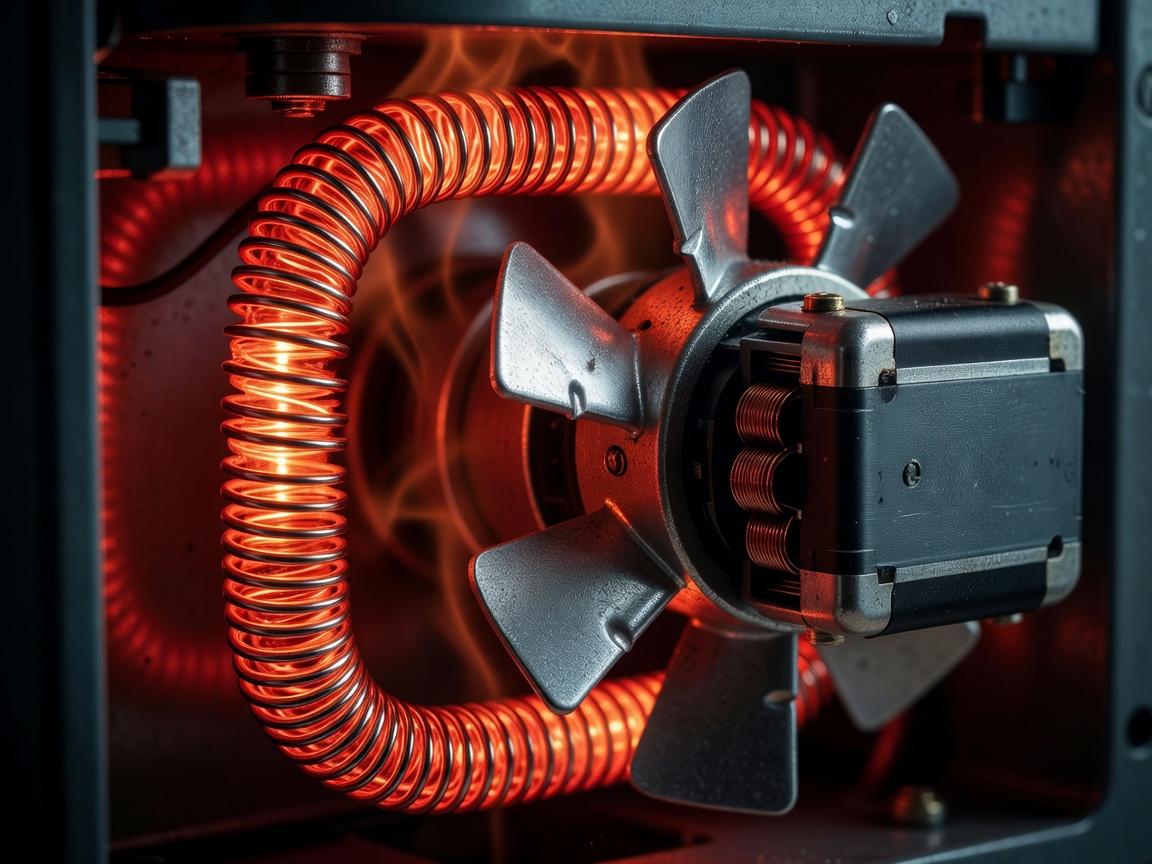
Despite the revolutionary marketing surrounding them, air fryers do not actually "fry" anything. Frying, by culinary definition, involves submerging food in hot liquid fat. Instead, an air fryer is essentially a highly efficient, miniaturized convection oven. Understanding how it operates will dramatically improve the quality of the meals you produce.
The Core Components
At its core, the appliance relies on two main components housed in the top of the machine: a concentrated heating element and a powerful mechanical fan. When you turn the machine on, the heating element (often a coiled metal tube similar to what you might see on an electric stovetop) rapidly heats up to your desired temperature, which can often reach up to 400°F (200°C) or more in just a couple of minutes.
Simultaneously, the fan positioned directly above the heating element begins to spin at high speeds. This fan forces the intense heat downward, circulating it rapidly around the food sitting in the perforated basket below.
Rapid Air Technology
This process of circulating hot air is known as convection. However, traditional convection ovens circulate air in a large cavity, which dilutes the intensity. The magic of "rapid air technology" lies in the appliance's restricted footprint. Because the cooking chamber is so small, the air moves significantly faster and with more focused intensity than in a standard oven.
The bottom of the cooking basket is explicitly designed to facilitate this airflow. The perforations and carefully engineered shapes at the base of the drawer ensure that the fast-moving hot air can bounce off the bottom and flow back up, enveloping the food from all 360 degrees. This is why you rarely need to flip food entirely over, though shaking the basket is still recommended to ensure uniform exposure.
The Maillard Reaction
To understand why this results in a "fried" texture, we have to look at the Maillard reaction. This is the chemical reaction between amino acids and reducing sugars that gives browned food its distinctive flavor and crunchy texture. For this reaction to occur rapidly and effectively, moisture on the surface of the food must evaporate.
In deep frying, the hot oil instantly boils away surface moisture, dehydrating the exterior of the food and triggering a rapid Maillard reaction. In an air fryer, the high-speed circulating dry air mimics this effect. It quickly wicks away surface moisture, allowing the outside of the food to dry out and crisp up while the interior remains trapped and steaming, cooking the inside gently.
The Role of Oil
While marketed as "oil-free," achieving true deep-fried textures usually requires a tiny amount of fat. A light spritz or toss in a single tablespoon of cooking oil coats the food. As the hot air blasts the ingredients, the oil heats up, essentially conducting a micro-frying process on the exact surface of the food without the need for total submersion. The fat acts as a conductive medium, ensuring a more even browning process than hot air alone can achieve.
Why It Beats the Traditional Oven
You might wonder why you shouldn't just use your regular oven. The answers are speed and efficiency. A large conventional oven takes 15 to 20 minutes just to preheat. An air fryer is often ready in three minutes or less. Furthermore, the compact cooking zone of the countertop appliance wastes far less ambient heat, making it an incredibly energy-efficient choice for daily meals.